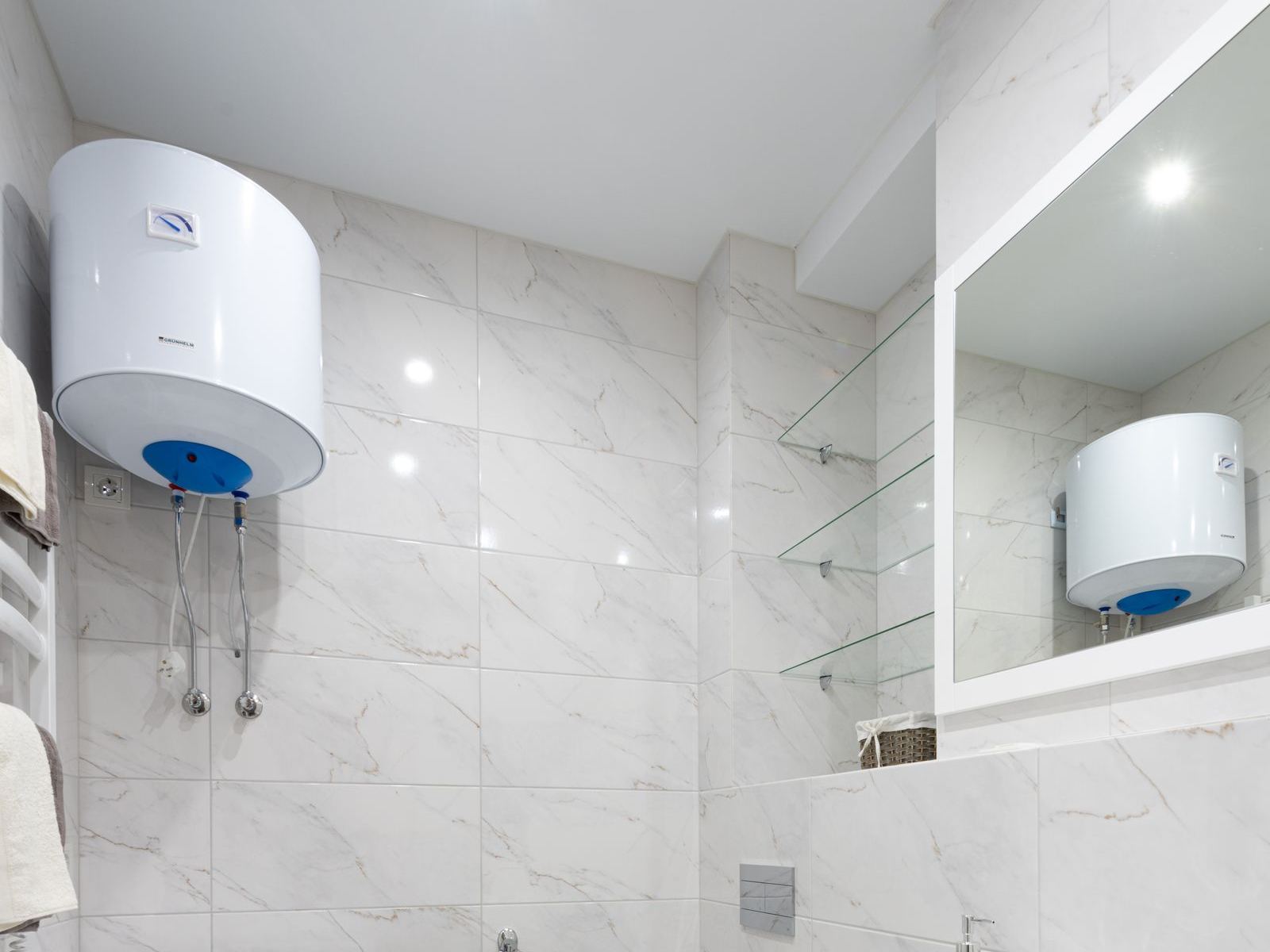
An electric water heater has no burner, no flame, and no vent, so it is tempting to think nothing much can go wrong. In practice, the parts that do the work (two heating elements, two thermostats, and a high-limit safety switch) fail in predictable ways. The upper thermostat heats the top third of the tank first, then switches power to the lower element. Lose the upper element or thermostat and the lower element never gets power, so the whole tank goes cold. If the lower element burns out, the top of the tank still heats, so you get a short burst of hot water that runs out fast. For St. Joseph, MO homeowners, knowing which symptom you have is the first step toward the right fix.
Resetting a tripped red button or swapping an element blindly rarely solves the problem for long. Our approach in St. Joseph homes is to test the whole circuit. We confirm the breaker and the 240-volt supply, measure the resistance of both elements, check each element for a short to ground, and verify that each thermostat opens and closes as it should. The wiring gets inspected too, from the junction box to the thermostat terminals. A high-limit that keeps tripping almost always has a reason, such as a thermostat stuck closed or a grounded element, and we find it so the button stays set.
Once we know what failed, the fix is usually quick. Elements, thermostats, and high-limit switches are standard parts, and our trucks carry the common sizes. Replacing an element means shutting off power, draining the tank, installing the new element, and refilling completely before power is restored, which protects the new element from a dry fire. Damaged wiring, loose terminals, and sediment on the tank bottom are handled in the same visit. If replacement makes more sense, we install new electric heaters sized to your household's first-hour demand, confirm the breaker and wire gauge are correct, and add the expansion tank, drain pan, and strapping your local code requires. Need electric water heater repair in St. Joseph? Call (816) 219-8425 today.
Our two most requested services are Water Heater Repair in St. Joseph and Water Heater Installation in St. Joseph. Start there if you're not sure what you need.
When to Call for Electric Water Heater Services
A heater that is starting to struggle rarely hides it for long, and the clues are easy to spot once you know them. Watch for these telltale signs that professional help is needed:
- A breaker that trips when the heater calls for heat
- No hot water at all from any faucet
- A heater that works after a reset, then quits again
- Crackling noises as the heater runs, often from sediment
- Water dripping from an element gasket or pooling under the tank
- Tap water much hotter than the thermostat setting
- Hot water that runs out after just a few minutes
- A burning smell or a discolored access panel near the thermostat
Small Symptoms, Big Consequences
A little rust-colored water or a relief valve that drips now and then can be the first hint of a tank that is close to the end. A quick call to (816) 219-8425 gets a technician out to check it before it becomes an emergency.
Talk to Us About Electric Water Heater Services
Call St. Joseph Water Heater for fast, reliable service.
Call (816) 219-8425 TodayFrequently Asked Questions About Electric Water Heater Services
Why This Job Calls for a Pro
Two things make electric water heater repair trickier than it looks: the power involved and the overlap between symptoms. Every element and thermostat connects to 240-volt terminals, and those terminals stay live until the breaker is off and the circuit is tested dead. On the diagnostic side, a heater that will not heat might have a failed element, a bad thermostat, a tripped reset, or a wiring problem, and a reset that keeps tripping is a warning, not an annoyance. Guessing gets expensive fast.
Our technicians bring proper meters and a disciplined procedure to every electric heater. They confirm power is off before touching terminals, test element resistance and ground faults, check thermostat operation, and find the reason a high-limit tripped instead of simply pressing it back in. When an element comes out, they drain the tank, check the sediment level, flush if needed, and refill completely before restoring power. You also get an honest opinion on the heater itself. If the tank is leaking or the heater is past about twelve to fifteen years, you will hear it from us before you spend money on a repair.
What to Expect From Our Team
Our workflow is simple and thorough, so nothing gets missed between the fuel supply and the relief line. Here's a look at each step our team takes:
Circuit & Component Testing
Before a part is ordered, we confirm power at the heater and test each element, thermostat, and connection to pinpoint what stopped the water from heating.
What Failed and What It Costs
You see what failed and learn why, then we give a firm price before starting. If the tank is leaking or the heater is near the end of its life, we tell you plainly.
Element & Thermostat Repair
Our trucks carry common elements and thermostats, so most repairs happen right then, including wiring fixes and a sediment flush when the lower element is buried.
Verified Heating
We restore power, confirm each element draws current in turn, check the water temperature, and make sure the high-limit stays set.
Not Sure What You Need?
Tell us the age, fuel type, and symptoms, and we'll help you sort out the next step.
Call (816) 219-8425 NowPrevention Tips That Actually Help
Most of the failures we see could have been delayed for years with basic upkeep. Here's where to begin:
- Ask for an anode rod check every few years, since the anode is what keeps the tank from rusting
- Consider a water softener if you have hard water, since it slows sediment and scale on the elements
- Treat a tripped high-limit as a warning sign, not a nuisance
- Drain a few gallons from the bottom of the tank periodically to control sediment
- Keep the thermostats set around 120 degrees to save energy and reduce scalding risk
- Lift the T&P valve lever yearly to make sure it opens and reseats
- After any draining, refill the tank fully and run a hot faucet before restoring power
Should You DIY or Call a Pro?
The line between a safe DIY check and a risky repair is usually the moment you need to open a gas fitting, a vent connection, or an electrical cover. Here's how the two approaches stack up:
| Consideration | DIY Attempt | Professional Service |
|---|---|---|
| Finding the Fault | Replace an element and hope | Every element and thermostat metered |
| Electrical Safety | Risk of shock or arc at the thermostat | Circuit tested dead, then work begins |
| Draining & Refilling | Dry-fired element burns out instantly | Tank drained, refilled, and purged of air first |
| Reset Button | Reason for the trip ignored | Cause of the trip found and fixed |
| Tank Condition | Sediment left burying the lower element | Tank and anode checked during service |
| Outcome | Element fails again within months | Real fault repaired and tested |
Book a Visit Today
The sooner you call, the sooner the hot water is back. Reach St. Joseph Water Heater for fast service.
Tap to Call (816) 219-8425Communities We Cover
We serve St. Joseph and its neighboring towns for electric water heater services, from quick same-day repairs to planned installs.